


Our technology
Secure Reception
Sorting
Storage by Category
Electrical Discharge
Cell-Level Disassembly and Component Storage
Cryogenization
Shredding
Electrolyte Extraction through Controlled Vaporization and Condensation
Gravitational-Aerodynamic Separation of Heavy and Light Fractions
Magnetic and Densimetric Separation of Heavy Fractions (Cu, Al, Fe, Plastic)
Black Mass Extraction
Densimetric Separation of Light Fractions (Cu, Al, Plastic)
Secondary and Recovered Raw Materials Reintegrated into the Economy
Advanced Processes, Total Safety, Maximum Resource Recovery
Our battery recycling facility is designed to manage the entire operational flow with maximum safety and high material efficiency. The process is divided into clearly defined stages, each monitored and recorded to ensure full traceability. This enables the controlled recovery of metal fractions, plastics, electrolytes, and black mass, which are subsequently delivered to authorized operators for refining. The technology applied is fully compliant with legal requirements and relevant international standards.
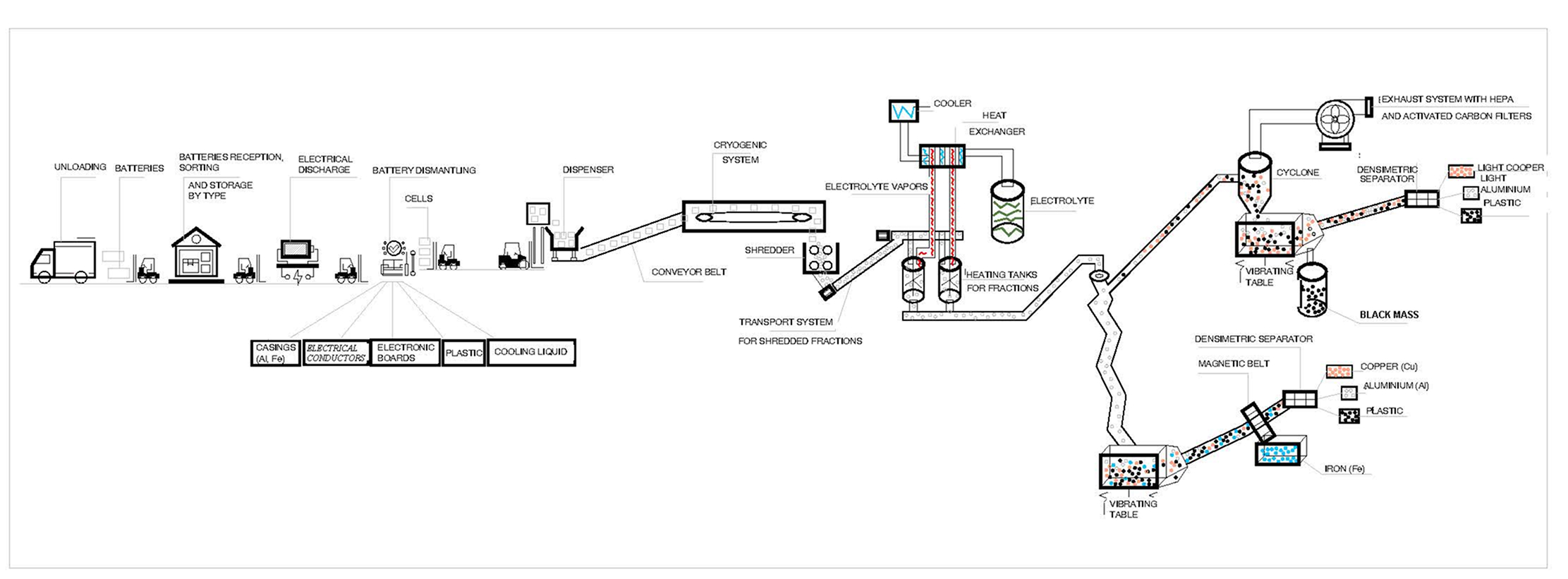
1. Secure Reception
Upon arrival at our facility, batteries are handled in accordance with strict ADR protocols. Approved containers and secure handling systems are used, minimizing the risk of short circuits, fire, or leaks. All shipments are digitally recorded and monitored through full traceability.
2. Sorting
Batteries are identified and classified by chemistry (Li-ion, Primary Lithium, NiMH, Alkaline), size, and physical condition by qualified personnel to ensure an optimal processing flow.
3. Storage by Category
Depending on sorting results, batteries are temporarily stored in specialized areas equipped with systems that regulate temperature, humidity, and other parameters. These conditions are maintained to prevent degradation or unwanted reactions.
4. Electrical Discharge
Before disassembly, batteries are fully discharged in a controlled system that recovers residual energy and redirects it for internal use or to storage batteries. Discharge parameters are adjusted according to cell chemistry to prevent thermal emissions.
5. Cell-Level Disassembly and Component Storage
Battery modules and packs are dismantled mechanically and manually down to the individual cell level. Connectors, cooling plates, and casings are separately collected and labelled. Complete isolation between cells is ensured to prevent short circuits in subsequent stages.
6. Cryogenization
Cells undergo cryogenic treatment with liquid nitrogen, lowering the temperature below -150 °C. This step eliminates the risk of self-ignition, makes the material structure more brittle, and facilitates subsequent shredding, reducing the release of toxic vapours.
7. Shredding
Cryogenically treated batteries are fed into a shredding system. Controlled granulation allows for preliminary material separation and prepares the batteries for electrolyte extraction.
8. Electrolyte Extraction through Controlled Vaporization and Condensation
Under controlled temperature and reduced pressure, the volatile electrolyte is vaporized and directed to condensation units. The result is high-purity recovered electrolyte, ready to be reintroduced into industrial processes.
9. Gravitational-Aerodynamic Separation of Heavy and Light Fractions
An air-flow and density-based classification system separates heavy materials (ferrous and non-ferrous metals, heavy plastics) from light fractions (Cu, Al, black mass, and polymeric separators). Air velocity and pressure parameters are calibrated according to the material’s particle size.
10. Magnetic and Densimetric Separation of Heavy Fractions (Cu, Al, Fe, Plastic)
Heavy fractions pass through high-intensity magnetic separators to extract ferrous components, and then through density classifiers to separate copper, aluminium, and plastic components.
11. Black Mass Extraction
Black mass, consisting of a mixture of lithium, cobalt, nickel, manganese, and other active material compounds, is recovered in a controlled environment to prevent oxidation. It is stored in sealed containers, ready for hydrometallurgical or pyrometallurgical refining.
12. Densimetric Separation of Light Fractions (Cu, Al, Plastic)
The remaining light fractions are processed in a density-based system adapted for low-density materials, yielding high-purity copper and aluminium, as well as recyclable technical-grade plastic.
13. Fractions and Secondary Raw Materials Reintegrated into the Economy
Recovered metals, black mass, electrolyte, and plastics are delivered to refineries and secondary raw material producers. The ECOWES process ensures an optimized recovery rate, reducing the carbon footprint and closing the loop of the circular economy.